Showing posts with label nature. Show all posts

Tuesday, 6 December 2016

Aubrey Beardsley and the Inescapable Music of the Pied Piper

The story of the Pied Piper of Hameln is well known. Of all its possible interpretations, I like to think of it as an allegory of the passage from autumn to winter. In Lower Saxony, where the story is set, this period of the year is fascinating. As if under the spell of the alluring notes played by the Piper, the richness and variety of colours transform the landscape day after day.

Autumn


The colours reach an indescribable intensity, reminiscent of the Piper's gaudy garment, and then fade softly, leaving only the veil of the winter frost to cover the bare arms of the trees.

Winter


It is probably not a case that the famous illustrator Aubrey Beardsley was one the many artists who have been inspired by this story. Among his very first publications, are precisely the illustrations for “The Pay of the Pied Piper” that formed part of the programme for the Christmas Entertainment at the Brighton Grammar School, in 1888.
The city of Hameln was infested by rats....
The rats follow the Piper outside the town

The Piper entices the children outside the town.

Although these were not the works that made him famous, some of the distinctive traits of his unique style are already present.


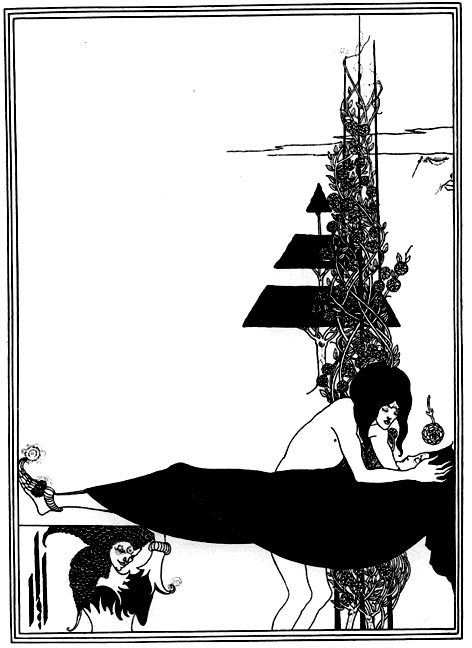
J'ai baisé ta bouche, Iokanaan - 1894

The platonic Lament - 1894


Black-and-white illustrations and a preference for grim stories.
Exaggerated garments and the recurring presence of skeleton-like figures.

.

The Black Cape - 1894

La Beale Isoud at Joyous Gard - 1894

These will famously become the emblematic figures of that decadent fin-de-siécle period in which Aubrey's short but intense career flourished.

Due to his weak health, Aubrey was well aware that a wintry veil would have soon covered his fragile body. And indeed, the inevitable notes of a Totentanz follow one another among the black lines of his illustrations.


Sara.


Saturday, 31 May 2014

The Hands of the Apes


Sometimes, the thought comes to my mind that the way we are living with our body is misleading. I get the strange feeling, for example, that my eyes are not entirely to see any more. It's not up to them, though. They have been doing an extraordinary job for 28 years and I am grateful to them for how they managed to overwhelm successfully hours spent in front of the laptop. But what about my part? Am I able to use my eyes up to their potential?

Our sight can spot target miles and miles away, but how many times during the day can we raise our eyes above the horizon? In most of the cases, this faculty is not of any use any more, even though the anthropologist C.L. Strauss wrote of a tribe with an extraordinary sense of orientation because they could spot Venus in the sky during day time. Then, he went to see old treaties of navigation and he found out that it was possible for old sailors of our civilisation as well, but we can not say if the rest of the humans lost this skill or simply forgot how to do it. (Claude Lévi-Strauss, Myth and Meaning, 1978)

In parallel, if the first Homo Sapiens could have a walk in our time, he would take just a few steps before suffocating. He could not live in a world with million of cars as we do, but probably he could rely much more on his nose for his every day life.

So, doubts raised on me about other parts of the body. I am not sure the mouth is for eating and the tongue to taste food. I am not even sure if my hands are grabbing correctly things I move from a place to another.

On the contrary, when I see Chimps on TV handling rocks or stick, I perceive they really mean those actions. Their hands seem to have a conscience on their own when they touch what soon will be a tool for fishing ants trough a hole in the ground. I started to believe that in these moments, their hairy hands are more hands than mines.

Wednesday, 12 February 2014

What Female Dragons can do.


The females of Komodo dragons can give birth to baby lizards without previous contact with males. This kind of asexual reproduction is called parthenogenesis and has been observed in females kept in captivity without any relations with opposite sex individuals for years, if not for all their life.

Komodo dragons are huge monitor lizards – up to 3 meters length- who live only in a few islands of central Indonesia. Most probably parthenogenesis could be for them the only solution to continue the species under extreme condition of isolation. In nature that can happen due to a storm which can lead astray a single varanus while swimming from island to island. Strong marine currents present in the area, could also carry the dragon far away from its group to an unpopulated territory.

The reproduction without fertilization of the egg can give birth only to male individuals because of genetic combinations. Females have chromosome ZW and all the eggs carry one chromosome, W or Z. Their union will give the male combination ZZ or WW. Eggs with the latter sequence are not going to hatch. Certainly, this way of procreating is not very healthy for the species being the genetic make-up derived only from one parent, but the offspring will grow normally and will be able to mate.

Parthenogenesis is very rare in vertebrates, but has been observed in snakes, fishes and even turkeys. Nevertheless, its discovery among Komodo dragons has been the reason to reconsider it as “not so exceptional”.

Monday, 10 February 2014

Toni Bruna, Formigole - english version

"Percorso artistico? Mi cominceria col dir che no son un artista... diria percorso creativo... xè comincià da subito, da quando che go memoria”

[My artistic path? To begin with, I'd say that I'm not an artist... creative path, I'd say... it started from the very beginning, since I can recall memories at all]


Toni Bruna doesn't seem to like definitions or labelling: artist, poet, singer, dialectal songwriter.
The instruments he makes use of for his musical creations, doubtlessly own much to the city he lives in, Trieste, a city clutched between the carso* and the sea. In fact, in his album Formigole (2011), one can find stories, impressions, faces, well-known places as well as forgotten corners of the city, but also the power of the natural elements and the solidity of the ground.
And just as the urban dimension fuses with the rural one, in the lyrics of his songs spiritual elements and more earthly ones live together. This combination results in images which may not always be clearly defined, but which bear a sharp expressive energy.
Tesounasanta is in my opinion one of the best examples.

tesounasanta
te ardi come el Monte Grisa
te vedo in testa
un'aureola de neon
o me confondo
cola plafoniera
dela cusina

[youareasaint
you glow like Monte Grisa**
I can see over your head
a neon-halo
or maybe I've mistaken it
for the kitchen ceiling-light]


The natural dimension too is of central importance for Toni Bruna. A dimension based upon simple,  but essential elements, which is often necessary to face in order to see with different eyes the complexity of every-day life.  Ants––the formigole which inspire the title of the album––represent a valid basis for comparison, according to the songwriter...


e le formigole
le sburta avanti e indrio le fregole
co le antene le se stuziga
qualche volta le se piziga
ma po' le se vol ben

e noi altri
restemo solo tra de noi, noi altri
qualche volte se misiemo
con quei altri de là
po' se demo pa'l muso
e restemo incazzai
sì, e restemo incazzai.

[ants
they push crumbles to and fro
they pick on each other with their antennae
sometime they tease each other
but they care for each other, eventually

we
we only stay among us, we
we sometimes mingle with those over there
then we hit each other in the face
and we keep getting pissed off
yes, we keep getting pissed off.]


Toni Bruna relies upon the potentialities of that which for him is the “only possible language”, namely the triestine dialect, which doesn't force the creative process within the limits and constraints of a language which is not the “maternal” one. Even in the choice of his means of expression, Toni Bruna wants to detach himself from pre-set categories:
 “no me piasi sta roba delle definizioni: el dialetto, la lingua (…) me piasi più l'idea che la lingua xè una roba che nassi spontaneamente, per la necessità che ga la gente de comunicar (…) no xè che te metterà 'desso la lingua in scatola, no? No te pol, la lingua xè viva e te devi accettar che xè cusì”
[I don't like this whole idea of giving definitions: dialect, language (…) I rather prefer the idea that a language is spontaneously born, from the necessity that people feel to communicate (…) now, you cannot just close the language in a box, can you? No, you can't, a language is something which is alive and one must accept that it is so.]


*The karst
**Mount located in the northern part of the city, on top of which sticks out a sanctuary dedicated to the Virgin Mary, renowned for the unmistakable shape that should ideally recall the letter “M”.

Wednesday, 22 January 2014

Bonobos in the Heart of Darkness

Photo by Tim Flach
part of the  "More than Uman" exhibition
Bonobos and chimpanzees are two similar kinds of primates. So similar that at a first glance you would say it’s only matter of size, being bonobos smaller than chimps. Yet the wide bends of the Congo River has played a big role in separating the two species. In fact, none of them swims -at least for such distances – and this has led to a significant difference in the development of their social organization.

Chimpanzee’s social system is based on the power of a male over a group whose members are framed by a well-defined hierarchy and clashes between neighbour communities are normal in case of border violation.

On the southern side of the Congo River, bonobos gave birth to a different reality. Here the close cooperation among females has wiped out what would be the physical advantage of the males. Male members are actually isolated individuals quite dependent on the mother, especially regarding their role in the group. But it has to be said that social status doesn't really matter among bonobos, for whom sex is the key to solve any form of conflict.

Sex is the way to soften competitiveness and everyone is doing it almost with everyone, without discrimination. When a group of bonobos find a new place to stay, a new happy island full of food in the jungle, general excitement makes that, first of all, collective sexual activities take place. After this every member will devote himself to the nourishment with less vehemence.

In the same region described on the novel Heart of Darkness by Joseph Conrad, bonobos have followed an alternative evolution, a parallel reality based on understanding, mutual aid, and physical contact.